


Small enterprise house owners usually get to expertise a particular sort of whiplash: You have got your largest income month ever, open your checking account, and assume, “Wait. The place did it go?”
The purchasers are there. The invoices are there. The calendar is packed. Your group is busy. However after payroll, contractors, software program, taxes, challenge overruns, admin time, and a few sudden revisions, the revenue is gone.
That’s an unlucky fact of company life: Busy and worthwhile should not the identical factor. Actually, a rising company can change into much less worthwhile as income rises if pricing, scope, utilization, and overhead should not managed rigorously sufficient.
Freelancer math is loads easier: Cash is available in, bills exit, and the distinction is yours. Company funds are a special animal when it’s a must to handle payroll, overhead, challenge profitability, utilization charges, and money circulate timing — and for those who don’t perceive the maths, you may be busy and broke on the similar time.
Company Monetary Fashions
Company funds have much more shifting elements than freelancers deal with: labor, utilization, overhead, cost timing, retainers, contractors, software program, taxes, founder compensation, and revenue.
The essential monetary mannequin is easy:
Income – Price of Supply (group salaries, contractor prices) = Gross Revenue
Gross Revenue – Overhead (hire, instruments, insurance coverage, admin) = Internet Revenue
However the exhausting half is ensuring you’re together with all the actual prices:
| Class | What It Contains |
| Income | All charges paid by purchasers |
| Direct labor | All salaries and wages paid to contractors and staff |
| Overhead | Software program Internet hosting Admin prices Bookkeeping Authorized charges Insurance coverage |
| Gross sales and advertising and marketing | Content material Adverts Networking Proposal time |
| Founder compensation | Your wage and/or proprietor draw |
| Revenue | All the pieces that’s left |
You’ll be able to’t simply have a look at income —income can rise whereas revenue falls. Promethean Analysis studies that the typical digital company earns 13% after-tax web margins in 2025, which is a helpful actuality test for anybody assuming company development routinely turns into simple revenue. A $40,000 month with 8% revenue is just not essentially more healthy than a $22,000 month with 35% revenue.
And right here’s a standard company pitfall to be careful for: you possibly can promote a challenge profitably however find yourself shedding cash if it goes over scope. A $10,000 challenge with a 30% goal margin means $7,000 budgeted for supply. But when scope creep pushes supply to $8,500, your margin drops to fifteen% earlier than overhead.
Pricing for Company Overhead
One of many largest errors a brand new company could make is charging freelance charges with company prices. Whenever you had been solo, your overhead was possible low, however company overhead contains salaries, payroll taxes, advantages, challenge administration instruments, accounting, insurance coverage, authorized prices, and unbilled hours for inner initiatives, skilled improvement, and sick days.
👉A helpful rule of thumb: Multiply your group’s totally loaded hourly value by three to get your minimal billable charge. If a designer prices you $50/hour totally loaded, the shopper charge should be $150/hour minimal. Under 2.5x, and most companies are working at or close to a loss.
Most new company house owners undercharge in 12 months one. It’s not as a result of they don’t know the maths, however as a result of the quantity feels daring. It will get simpler. Quote it anyway.
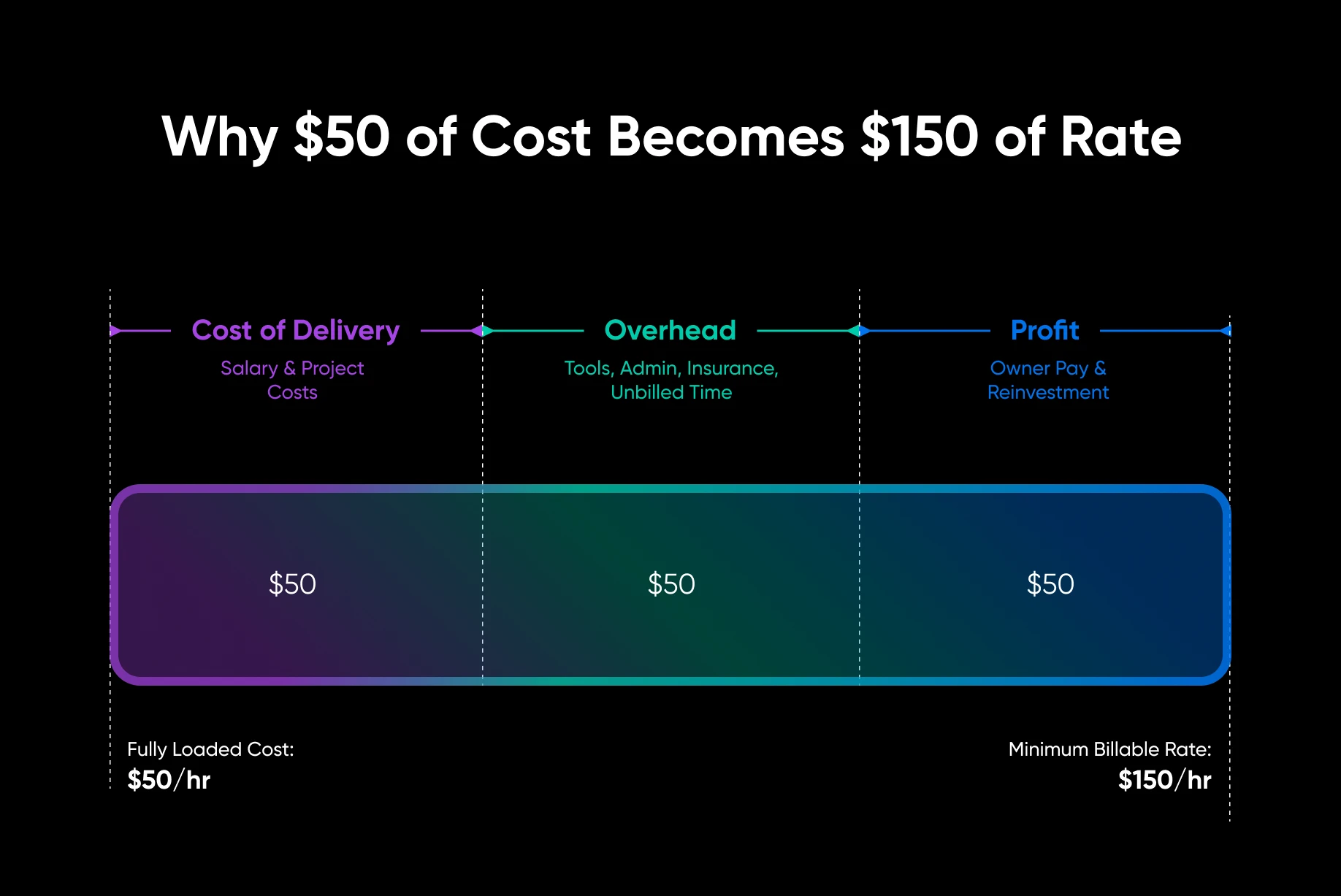
Right here’s how the multiplier breaks down:
| Part | Share of Billable Fee | What It Covers |
| Price of supply | ~33% | Wage Contractor prices Direct challenge bills |
| Overhead | ~33% | Hire Instruments Admin Insurance coverage Unpictured hour |
| Revenue | ~33% | Enterprise revenue Proprietor compensation Reinvestment |
Utilization Charges and Capability
Utilization charge measures what share of accessible hours go to billable shopper work versus inner conferences, admin, and the whole lot else that doesn’t generate income.
If somebody works 40 hours per week, they gained’t spend 40 hours on billable shopper supply — they want time for conferences, admin, coaching, inner communication, breaks, and the easy undeniable fact that no human operates at 100% effectivity and productiveness.
A wholesome utilization goal depends upon function, however many companies use ranges like these:
| Position | Attainable Goal Utilization |
| Manufacturing specialist | 70-80% |
| Strategist | 60-75% |
| Venture supervisor | 50-70% |
| Founder | Varies broadly, however ought to lower over time |
These are targets, not verdicts. Every week at 60% occurs. A month at 60% is a sign value taking a look at.
Increased isn’t all the time higher; if utilization is simply too excessive, individuals don’t have any room for enchancment, coaching, gross sales assist, sudden shopper wants, or relaxation.
Bench time is the alternative downside — a group member is obtainable, billable, and never billing something. It feels nice proper up till payroll clears. Some bench time is regular, however an excessive amount of of it might imply you employed forward of demand or your gross sales have slowed down.
The actual repair is often structural — a stronger pipeline retains bench time uncommon, and versatile contractor preparations imply you’re not locked into full-time prices throughout sluggish stretches.
Profitability Optimization
Bettering profitability doesn’t all the time imply charging extra.
You too can enhance revenue by tightening scope, lowering reworks, enhancing handoffs, standardizing deliverables, promoting retainers, or dropping low-margin providers.
Widespread areas the place revenue margins slender embrace:
- Promoting customized work at bundle costs
- Making limitless revisions
- Redoing group work your self
- Letting the scope change and not using a formal settlement
- Letting initiatives drag previous their agreed-upon timelines
- Not charging for upkeep or assist
- Not charging for technique
- Having too many instruments with overlapping capabilities
Scope administration is commonly your largest profitability lever. Most challenge overruns are attributable to scope that creeps and expands with out corresponding payment will increase. Outline the scope exactly in each contract, embrace a transparent change order course of, and prepare your group to flag out-of-scope requests earlier than engaged on them.
Construct an Company Profitability Dashboard
Construct a easy spreadsheet with these 5 numbers and replace it month-to-month.
- Absolutely loaded group value per hour: (annual salaries/wages + taxes + advantages)/annual working hours = $____/hour
- Minimal billable charge: Price per hour x 3 = $____/hour
- Utilization charge: Final month’s billable hours/whole accessible hours = ____%
- Month-to-month break-even: Complete fastened prices/goal gross margin = $____
- Recurring income ratio: month-to-month recurring income/whole income = ____%
Preserve the Enterprise Wholesome Sufficient to Do Its Finest Work
Profitability means constructing an company that may maintain its guarantees, pay its group, spend money on higher methods, give purchasers a smoother expertise, and survive the occasional sluggish month with out panic.
That’s the actual level of monetary self-discipline. It provides the company room to breathe.

Monetary Automation
Cease Chasing Invoices. Automate Your Enterprise Funds.
A free playbook for small companies: automate expense monitoring, funds, money circulate forecasting, and tax prep from one related system.
Get the Free eBook
Did you get pleasure from this text?

