

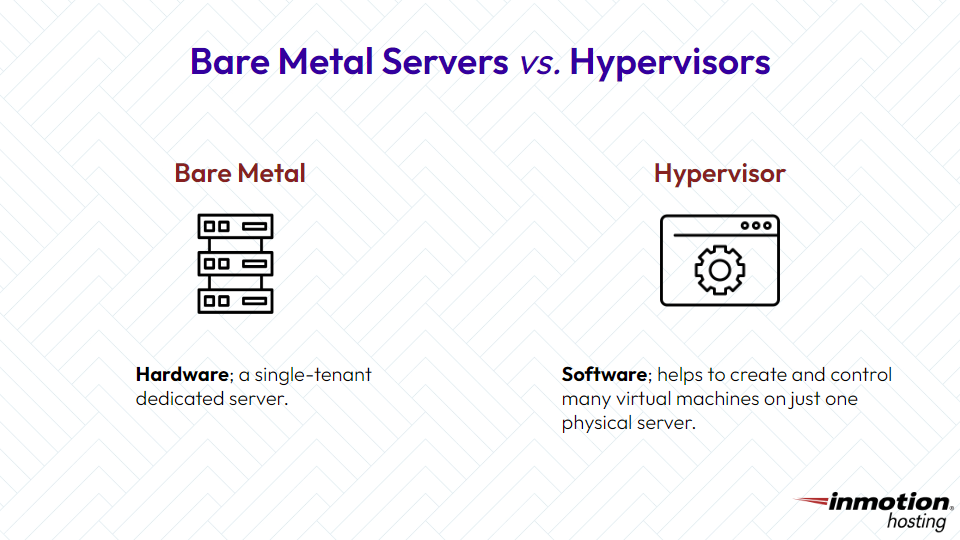
Naked metallic servers and hypervisors will not be competing applied sciences. A naked metallic server is bodily {hardware}; a hypervisor is software program that creates digital machines on that {hardware}. Understanding this distinction helps you determine whether or not to run workloads immediately on devoted {hardware} or add a virtualization layer.
This text explains what naked metallic servers and hypervisors are, how they differ, and the way the 2 can work collectively to construct versatile, high-performance infrastructure.
A naked metallic server is a bodily machine devoted fully to a single tenant. The working system communicates immediately with the {hardware} elements, together with CPU, RAM, storage, and community interfaces, with none intervening virtualization layer.
The time period “naked metallic” refers back to the direct relationship between software program and {hardware}. Once you set up an working system like Ubuntu, AlmaLinux, or Home windows Server immediately on a bodily server, you’re working on naked metallic.
Naked metallic servers excel in situations requiring:
- Uncooked Efficiency: No hypervisor overhead means functions entry 100% of accessible CPU cycles and reminiscence bandwidth
- Predictable Latency: Direct {hardware} entry eliminates the variable latency launched by virtualization layers
- {Hardware}-Degree Customization: Full management over BIOS settings, firmware, RAID configurations, and kernel parameters
- Compliance Necessities: Single-tenancy supplies bodily isolation for workloads topic to regulatory mandates
For resource-intensive functions like databases, real-time analytics, high-frequency buying and selling programs, and machine studying coaching, naked metallic servers ship the constant efficiency these workloads demand.
Hypervisors: A Software program Layer
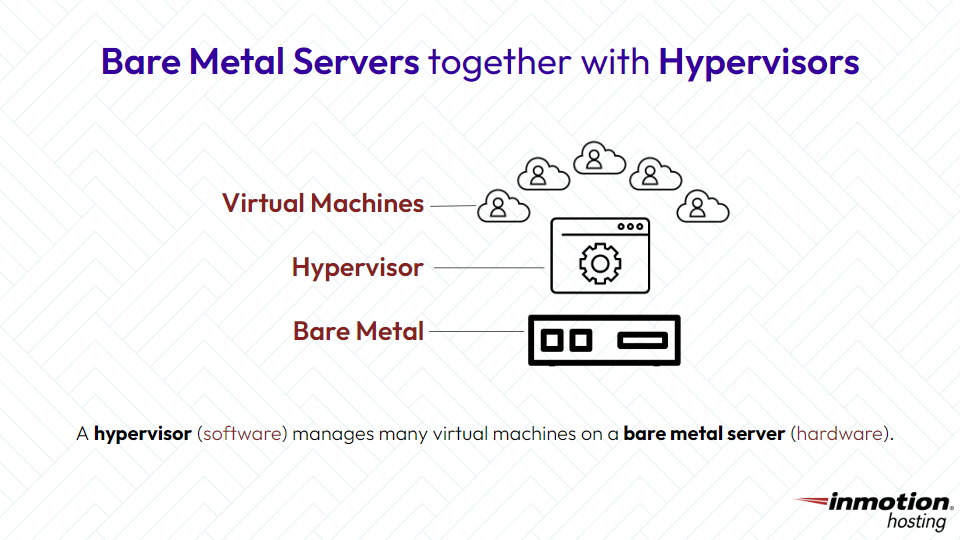
A hypervisor is software program that creates and manages digital machines (VMs) by abstracting bodily {hardware} into a number of remoted environments. Every VM operates as if it have been working on devoted {hardware}, full with its personal working system and functions.
Hypervisors divide bodily sources, together with CPU cores, RAM, and storage, amongst a number of VMs working concurrently on the identical server. This useful resource sharing permits organizations to run numerous workloads on fewer bodily machines.
Kind 1 Hypervisors (Naked Metallic Hypervisors)
Kind 1 hypervisors set up immediately on bodily {hardware} with out requiring a bunch working system. They perform as a skinny software program layer between the {hardware} and the visitor working programs working in every VM.
Alternatively, hypervisors aren’t bodily issues; they’re software program layers that create a separation between {hardware} elements and the working system. This separation makes it doable to create and handle a number of digital machines, every working its personal working system.
Widespread Kind 1 hypervisors embrace:
- VMware ESXi: Enterprise-standard hypervisor with in depth administration capabilities by means of vSphere. Following Broadcom’s 2023 acquisition of VMware, licensing has shifted to subscription-based fashions, and the free ESXi tier has been discontinued.
- Proxmox VE: Open-source platform combining KVM virtualization with LXC containers. Proxmox has gained important adoption since 2024, notably amongst organizations in search of options to VMware’s new licensing construction.
- Microsoft Hyper-V: Built-in with Home windows Server environments and Azure hybrid cloud deployments
- KVM (Kernel-based Digital Machine): Linux kernel module that transforms supported Linux distributions into Kind 1 hypervisors
Kind 1 hypervisors ship near-native efficiency as a result of they entry {hardware} immediately fairly than by means of an middleman working system.
Kind 2 Hypervisors (Hosted Hypervisors)
Kind 2 hypervisors run as functions on prime of a traditional working system. The host OS manages {hardware} entry, and the hypervisor creates VMs inside that surroundings.
Examples embrace:
- Oracle VirtualBox: Free, open-source choice widespread for desktop virtualization
- VMware Workstation: Skilled-grade desktop virtualization for improvement and testing
- Parallels Desktop: macOS-focused virtualization for working Home windows functions
Kind 2 hypervisors introduce further overhead as a result of VM requests should go by means of each the hypervisor and the host working system. They’re finest fitted to improvement environments, software program testing, and working secondary working programs on private workstations fairly than manufacturing server deployments.
Naked Metallic Servers for Most Efficiency
Get direct {hardware} entry with out virtualization overhead. Naked metallic servers ship the best efficiency for demanding functions.
 {Hardware} That is Fully YoursUncooked Server EfficiencyFull Customization Freedom
Naked Metallic Servers
Putting in a Kind 1 hypervisor on a naked metallic server creates a robust mixture: the uncooked efficiency of devoted {hardware} supporting a number of remoted digital environments.
This configuration permits organizations to:
- Consolidate Workloads: Run 10, 20, or extra VMs on a single bodily server as an alternative of sustaining separate machines for every utility
- Isolate Environments: Maintain manufacturing, staging, and improvement workloads on the identical {hardware} whereas sustaining full separation
- Maximize {Hardware} Funding: Allocate idle sources to further VMs fairly than leaving CPU cycles and reminiscence unused
- Allow Fast Provisioning: Spin up new VMs in minutes fairly than ready for bodily server deployment
The hypervisor manages useful resource allocation dynamically. If one VM experiences a site visitors spike, the hypervisor can allocate further CPU time and reminiscence from the shared pool. When demand subsides, these sources develop into accessible for different VMs.
Useful resource Allocation Instance
Take into account a naked metallic server with 64 CPU cores and 256 GB of RAM working Proxmox VE:
- Net Utility Cluster: 3 VMs with 4 cores and 16 GB RAM every
- Database Server: 1 VM with 16 cores and 64 GB RAM
- Growth Environments: 4 VMs with 2 cores and eight GB RAM every
- Monitoring and Logging: 2 VMs with 2 cores and 4 GB RAM every
This configuration makes use of 44 cores and 168 GB RAM, leaving headroom for added VMs or burst capability.
InMotion Internet hosting’s naked metallic servers assist hypervisor installations, offered the server specs accommodate the hypervisor software program necessities plus the sources wanted in your deliberate VMs.
Minimal Necessities for Widespread Hypervisors
Proxmox VE:
- 64-bit CPU with Intel VT-x or AMD-V virtualization extensions
- 2 GB RAM minimal for the hypervisor itself (8 GB or extra advisable)
- Extra RAM allotted per VM based mostly on visitor necessities
- SSD storage advisable for VM disk photographs
VMware ESXi 8.0:
- 64-bit x86 processor on the VMware {Hardware} Compatibility Record
- 8GB RAM minimal (12 GB or extra advisable for manufacturing)
- 32 GB boot disk minimal
- Gigabit or quicker community adapters
KVM on Linux:
- 64-bit processor with {hardware} virtualization assist
- Linux kernel 2.6.20 or later (fashionable distributions embrace KVM by default)
- RAM necessities differ by distribution and deliberate VM depend
InMotion Internet hosting’s Business Class naked metallic servers present Intel Xeon processors with virtualization extensions, as much as 512 GB ECC DDR4 RAM, and NVMe SSD storage. These specs exceed the necessities for enterprise hypervisor deployments and supply substantial headroom for working a number of manufacturing VMs.
When planning a hypervisor deployment, reserve sources for the hypervisor itself. An inexpensive baseline is 2 to 4 CPU cores and eight to 16 GB RAM for hypervisor operations, with remaining sources accessible for VMs.
Supported Working Techniques
InMotion Internet hosting naked metallic servers will be deployed with AlmaLinux, Ubuntu, or Debian. For hypervisor installations:
- Proxmox VE: Set up immediately utilizing the Proxmox ISO, or deploy on Debian and add Proxmox packages
- KVM: Obtainable on any supported Linux distribution; set up the libvirt and QEMU packages
- VMware ESXi: Requires separate licensing from Broadcom/VMware
Contact InMotion Internet hosting’s technical gross sales crew to debate particular hypervisor deployment necessities in your use case.
Not each workload advantages from virtualization. Run functions immediately on naked metallic when:
- Most single-application efficiency issues: Databases, analytics engines, and rendering workloads typically carry out higher with direct {hardware} entry
- Licensing constraints exist: Some software program licenses are tied to bodily {hardware} or have complicated virtualization phrases
- Latency sensitivity is vital: Monetary buying and selling programs, real-time management programs, and sure gaming servers require the predictable latency of naked metallic
- {Hardware} passthrough is inadequate: Whereas hypervisors assist GPU and NIC passthrough, some specialised {hardware} integrations work higher on naked metallic
- Simplicity is valued: Fewer software program layers imply fewer potential factors of failure and less complicated troubleshooting
When to Add a Hypervisor
Virtualization is sensible when:
- You want workload isolation: Separate functions into distinct VMs with their very own working programs and safety boundaries
- Useful resource utilization is low: In case your server runs at 10% to twenty% CPU utilization, virtualization can consolidate a number of workloads
- Testing requires a number of environments: VMs allow fast creation and destruction of check environments
- Catastrophe restoration is a precedence: VM snapshots and reside migration capabilities simplify backup and failover methods
- You’re working combined working programs: A single naked metallic server can host Linux and Home windows VMs concurrently
The 2026 Hypervisor Panorama
The virtualization market has shifted considerably since Broadcom acquired VMware in late 2023. Key modifications embrace:
- VMware Licensing Restructuring: Per-core subscription pricing has elevated prices for a lot of organizations, notably small and mid-sized companies.
- Free ESXi Discontinuation: The free tier that served dwelling labs and small deployments is now not accessible.
- Open Supply Adoption Development: Proxmox VE has seen substantial adoption will increase from organizations in search of cost-effective options with comparable options.
For organizations evaluating hypervisor choices in 2026, Proxmox VE provides excessive availability clustering, reside migration, built-in backup, and web-based administration with out licensing charges. Enterprise assist subscriptions can be found for organizations requiring assured response instances and entry to secure replace repositories.
VMware vSphere stays the usual in giant enterprises with current VMware investments and necessities for particular third-party integrations. Hyper-V continues to serve Home windows-centric environments, notably these built-in with Azure.
Making the Proper Selection
The choice between naked metallic alone, naked metallic with a hypervisor, or cloud-based VMs relies on your particular necessities:
| Issue | Naked Metallic | Naked Metallic + Hypervisor |
|---|---|---|
| Efficiency | Most for single workload | Close to-native with correct sizing |
| Flexibility | Restricted to at least one OS occasion | A number of VMs with totally different OSes |
| Utilization | Will depend on workload | Greater by means of consolidation |
| Complexity | Decrease | Greater (hypervisor administration) |
| Price per workload | Greater | Decrease when consolidating |
InMotion Internet hosting supplies each managed devoted servers with Premier Care assist and self-managed naked metallic servers for organizations with in-house technical experience. Whether or not you’re working a single high-performance utility or deploying a virtualized infrastructure, the underlying {hardware} determines what’s doable.
For questions on naked metallic server specs, hypervisor compatibility, or deployment help, contact InMotion Internet hosting’s technical gross sales crew.

