


In much less time than it takes to learn this sentence, individuals have already determined how they really feel about your small enterprise.
Design does a lot of speaking.
And colour is core to that.
Consumers aren’t shallow; it’s actually simply psychology.
The fitting palette can immediately begin constructing belief. It might probably make you recognizable and lodge you in customers’ brains, creating loyalty.
The fallacious palette, or an eleventh-hour change to the one you’ve chosen, can scare off prospects — they usually themselves could not even know why.
Are you slightly scared, but in addition slightly excited?
You then’re within the good headspace to dive proper into how to decide on your model colours nicely.
What Is a Model Shade Palette?
A model colour palette is a set of colours that you simply use persistently throughout every thing that represents what you are promoting: web site, social media, packaging, e-mail templates, and advertising supplies.
These colours are a deliberate visible system that creates recognition, indicators your persona, and communicates your values at a look.
For instance, whenever you spot that acquainted robin’s egg blue on a Tiffany & Co. field, you don’t have to see the brand. The colour is the model.
Take into account the Psychology of Shade
Colours aren’t impartial — heck, even “neutrals” aren’t actually neutrals!
Colours carry emotional weight formed by cultural conditioning and private expertise. These associations straight affect how individuals understand your model earlier than they’ve consciously registered something about it.
Right here’s what your colours are saying earlier than anybody reads a phrase:
- Blue: Belief, reliability, calm. Used broadly in tech, finance, and healthcare.
- Inexperienced: Nature, well being, sustainability, progress. Frequent in wellness, meals, and eco-focused manufacturers.
- Crimson: Power, urgency, ardour, urge for food. A robust action-driver, however use it sparingly — it could actually really feel aggressive.
- Yellow/gold: Optimism, heat, friendliness. Nice as an accent; overwhelming as a dominant colour.
- Purple: Creativity, luxurious, knowledge. Typically utilized in magnificence and premium product classes.
- Black: Sophistication, authority, magnificence. Indicators premium and high-end positioning.
- White/impartial: Simplicity, cleanliness, openness. A dependable backdrop that lets different colours breathe.
- Orange: Playfulness, affordability, power. Attracts consideration with out the depth of pink.
Your colours ought to really feel congruent along with your model persona and what your ultimate buyer is in search of.
Select Your Colours
You don’t want a design diploma to construct a fantastic colour palette, ya want a course of.
And also you’re in luck, as a result of subsequent up is one that truly works for busy small enterprise homeowners.
Step 1: Get Clear on Your Model Persona
Earlier than you get any additional, reply these questions:
- What three phrases describe the sensation I need my model to evoke? Return to your values right here in the event you’re caught.
- What does my ultimate buyer have to really feel to belief me and purchase from me? Once more, you possibly can return to any voice documentation you’ve created to brush up in your ultimate viewers.
- Are there manufacturers I like visually whose colours really feel proper for what I’m constructing? Go on Instagram or TikTok and have a look at your feed to save lots of them to your swipe file.
These solutions are your temporary. Every thing else flows from right here.
Step 2: Begin With One Anchor Shade
Decide one colour that greatest represents your model persona out of your Step 1 solutions. This turns into your main colour, the one your viewers will most strongly affiliate with you.
Most of all, don’t overthink it. Decide a colour and stay with it for per week to see the way it feels. In the end, you possibly can at all times pivot and refine later.
Step 3: Construct Out a Palette of 3-5 Colours
To create a robust model, you actually solely want three to 4 colours. Any greater than this may dilute your model identification and make it tougher for purchasers to acknowledge you.
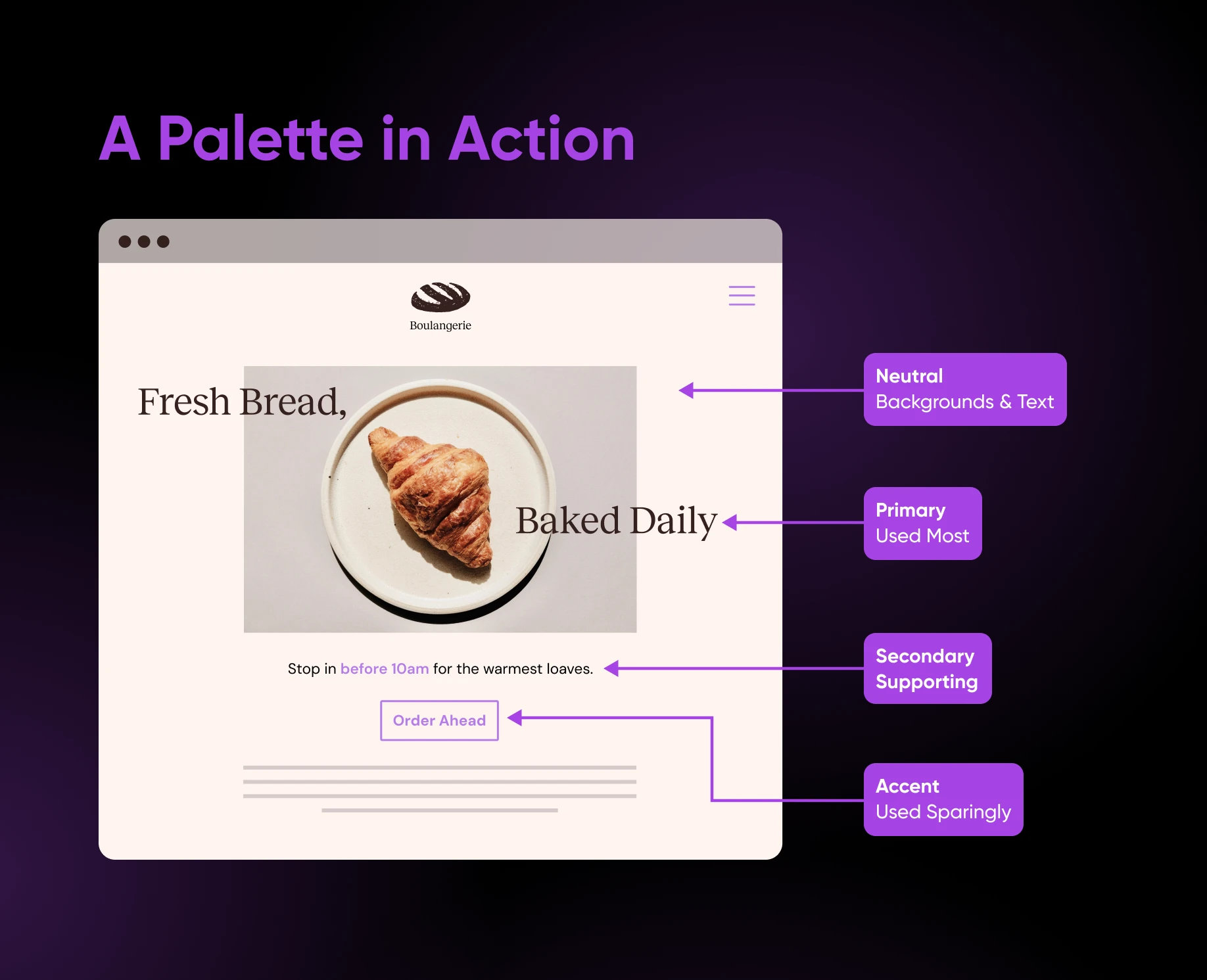
A practical palette usually contains:
- 1 main colour: Your dominant model colour, used most continuously (chosen above).
- 1-2 secondary colours: Supporting colours that complement your main.
- 1 impartial: Often white, cream, mild grey, or black, used for backgrounds and textual content.
- 1 accent colour: A daring pop used sparingly for buttons, highlights, and calls to motion.
Take into account your business norms, however don’t really feel locked into them.
Manufacturers that need to stand out can attain for surprising colours to sign innovation, whereas established manufacturers emphasizing reliability could profit from standard, trust-evoking colours.
Step 4: Check Your Colours in Context
Colours look completely different on display than they do in your head. Earlier than committing, take a look at your palette on precise designs — even a easy mockup of your web site header, or a social media put up template.
Our information to web site colour schemes is a useful useful resource for seeing how varied palettes look in actual web site contexts, with 40 curated examples throughout completely different kinds and industries.
Step 5: Report Your Palette With Hex Codes
When you’ve landed in your colours, file the hex codes (six-character colour identifiers like #F4A261) for each colour in your palette.
These are the precise codes you’ll want sometimes when working with templates, designers, and printers.
Having them written down in a single place means your colours will at all times be constant, no matter what instrument or supplier you’re utilizing.
Give attention to Accessible Shade Mixtures
Inaccessible colour decisions imply a portion of your viewers actually can’t learn your web site.
Notably, colour distinction is the highest accessibility violation on the net.
So earlier than finalizing your palette, run your colour mixtures by WebAIM’s free Distinction Checker. Paste in your hex codes, and it tells you immediately whether or not you cross or fail the requirements set by the Internet Content material Accessibility Pointers (WCAG).
Three fast guidelines to remember:
- By no means use colour as the one solution to sign one thing vital, like an error message.
- Watch out with textual content overlaid on images or gradients; these are the commonest culprits.
- Mild grey textual content on a white background will virtually at all times fail, even when it seems effective in your display.
These three free instruments will get you a lot of the approach there to constructing a professional-looking colour palette
- Coolors is a quick and intuitive place to begin: Hit the spacebar to generate a palette immediately, lock in colours you want, and preserve producing till you land on one thing that feels proper. You can even add a picture, and it’ll extract a palette mechanically.
- Adobe Shade is an effective choice if you wish to perceive why sure colours work collectively: Construct palettes utilizing colour concord guidelines, add photographs to extract themes, and run a built-in accessibility test.
- Canva’s Shade Palette Generator is right in the event you’re already utilizing Canva to your advertising: Add a photograph or choose a beginning colour to browse a whole bunch of Canva templates constructed round your chosen palette.
Why a Stable Shade Palette Is Crucial for Small Manufacturers
In accordance with a 2025 Adobe survey, half of all customers have chosen one model over one other based mostly on colour alone, and near half (46%) say a model’s colour scheme is vital after they’re making a purchase order.
Shade additionally builds the type of loyalty that retains prospects coming again.
One in three customers mentioned they’re extra more likely to keep loyal to manufacturers that don’t change their colours. For a small enterprise working laborious to construct a repeat buyer base, that’s a compelling case for nailing it after which maintaining it constant.
Craft a Palette That Earns Its Preserve
Selecting your model colours isn’t nearly vibes, and even copying what’s well-liked proper now.
Turns on the market’s a course of for this, and it really works.
It begins with getting clear in your model persona, selecting one anchor colour you’re keen on, and constructing out a targeted palette of simply three to 5 colours that work collectively.
From there, put ‘em to the take a look at.
You need to mock up your colours on actual designs, run each mixture by a distinction checker so everybody can learn your web site, and file your hex codes in a single place. You possibly can lean on free instruments like Coolors or Adobe Shade whenever you get caught.
The final piece of the puzzle is staying constant.
Companies that present up with the identical colours all over the place — web site, social, packaging, e-mail — are those prospects acknowledge, belief, and return to.

[Download] 2026 Small Enterprise Branding on a Bootstrap Finances
Your Model Is Working Earlier than You Say a Phrase
Half of all customers have chosen one model over one other based mostly on colour alone, and one-third of manufacturers noticed substantial income progress because of constant branding. This 40-page DIY playbook provides small enterprise homeowners the technique, voice, colour palette, brand, typography, and elegance information blueprint to construct a pro-level model with free instruments, no designer required.
Get the eBook
Did you get pleasure from this text?

